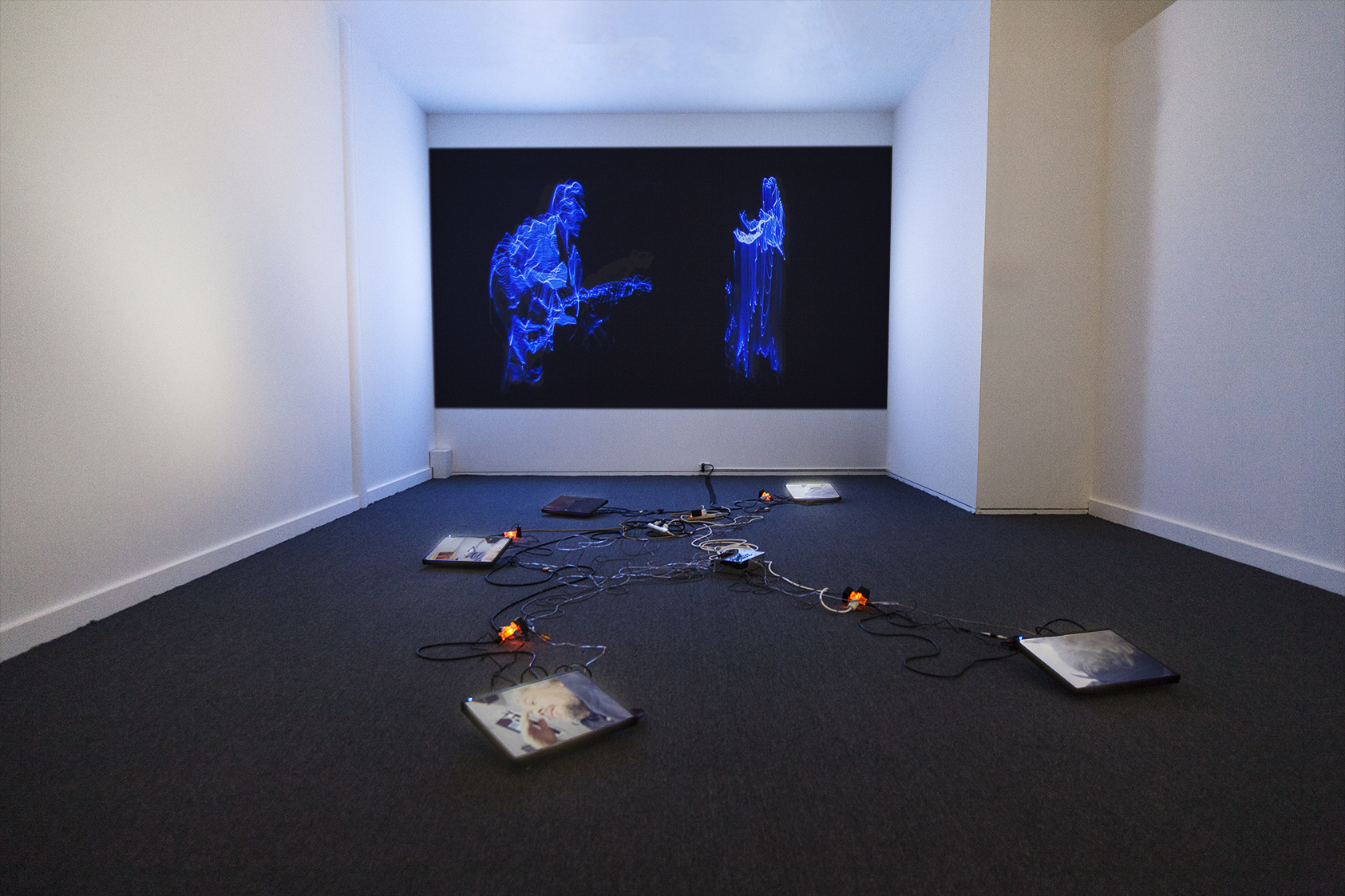

Garry Hill Exhibition Catalogue is Now Out
The catalogue, designed by Noa Schwartz and kobi Barhad is avaliable now at the CCA or via mail order: 03-5106111 for only 35 NIS.
Gary Hill in an Interview with Sergio Edelsztein
The complete interview can be found in the printed catalogue
S: You often use the term “liminal”. What is the meaning of this “threshold” for you?
G: I find that I work between media rather than doing installation, video, conceptual art, language, etc. All those categories kind of disappear when you’re inside the process. There is a sense of suspended animation that allows things to happen in different ways. It rather means a kind of resistance to a final logical conclusion to just about anything. It definitely has to do with resistance.
S: Which brings me to the importance of drugs in your work…
G: I would say that’s a little overstated. On the other hand, I would never deny that taking LSD was an early life-changing event for me. I still on occasion do that kind of practice, as a kind of mind inventory, a return to an experience that is always refreshing. The psychoactive space is important to me; it is a philosophical space. I don’t really think of psychedelics as drugs per se, they are more like tools. Just recently there was an expansive East Coast event called Psychedemia (an interdisciplinary conference on psychedelic art, culture, and science that took place in Philadelphia at the University of Pennsylvania over the weekend of September 27-30, 2012. Its name is a reflection of its mission: integrating psychedelics into academia). Many well-known writers, philosophers, doctors and artists attended. There’s a kind of rekindled interest in psychedelics across the board over the past few years, not only for terminal patients, but also in terms of exploring the psychedelic experience.
S: Do you mean the study of psychogenetic phenomena or rehabilitation of the use of drugs?
G: Yes, actually the use. In fact, the government has changed its policy to a certain degree and the use of LSD is now allowed in limited controlled studies. It was illegal from the late 1960s until recently.
S: I ask because I have a feeling that this liminal threshold has to do with something you experienced, something very subtle.
G: I had a car accident in 1981, where I thought I was dying, and that was most definitely a space of liminality. I literally said to myself, “wow, this is what it’s like to die.” I was in total acceptance; in awe, like, “this is it.” There was just nothing. I crashed into a tree. I was in the passenger’s seat and had a seatbelt on. If I hadn’t, I’d have been unrecognizable. I was in extreme pain. My ribs were broken. I remember having to piss and instead of getting out of the car, as I struggled for a moment to do, I smiled to myself thinking I was dying anyway and let go. I saw the tree golden, in extreme slow motion. I don’t know if I saw that as it was happening or I replayed a movie of my own making. All these life after death questions could be a shock and/or brain chemistry qua survival mechanism. I don’t know what it is. No one knows what it is, but the experience was undeniable.
S: Do you think this experience affected your work?
G: Well it certainly affected my life and that affects my work; it’s quite circular really. The gift of life and its fragility is embedded forever after an experience like that. And I would say that there is something about it that is similar to a large dose of LSD. Experiences of the space between life and death, or space and time, or body and mind become rather subtle distinctions. It’s really difficult to pinpoint what actually influences art making. I don’t think you can separate psychedelic journeys, car crashes, close call brushes with death, or raising a child. No, they’re all woven together, and are interrelated, and resonate and reverberate together, much like when you come up with an idea, a flash or trigger in your mind. You don’t sit there and question where it comes from, but you believe it, that’s the thing. In my art making, there is some belief. It’s not like I can prove anything, I just believe in something.
S: What is there to believe in? Let’s say it’s not God, but rather a liminal situation.
G: It’s embracing an experience or a phenomenological occurrence. It doesn’t have to be more.
S: But is it internal? Maybe chemical?
G: I don’t know. I could either spend time making art, or spend it trying to find that out. I suppose we’re always doing a little of both as there is always a doubt.
S: Exactly. But, in a way, a lot of your art, besides the focus on language, is about the way you work with your body. Your work points to an internal feeling of your body, I’m thinking about works like, Up Against Down, and even Writing Corpora, the formation of which is about a strong bodily presence that is very internal; it comes from the inside, from experience.
G: The focus on the body comes from the desire of physicality that may very well arise from working with ephemeral media. The body represents mortality. More than anything, we experience fragility through the body. When I work with language, it’s really [in order] to give a thought physical form, to try to touch what thought is.
S: It’s the same liminal thing. But if you want to give a thought physical form, then you also want to liminalize the body. Since we were talking of skateboarding and surfing, much has been written about surfing as a formative experience actually informing your art…
G: The ideal surf experience, the projection that one has of it, is being inside a wave. It’s called the “green room,” or “tube” and it’s the idea of being in that space and time perfectly; something like a still point in which space and time evaporate.
S: But that is the ultimate fragile situation. Actually, it will reverse in a second – you just try to postpone that moment…
G: When we say, “a fraction of a second,” it’s relative, it could be a lifetime. It’s suddenly that time is absorbed by zero. In Aniara, a science fiction poem written by Harry Martinson in 1956, there’s a beautiful metaphor where he talks about the infinity of space, the vastness of space, and refers to a wine glass that has an imperfection in it, like a little bubble in the glass, and over a thousand years that bubble might move a millimeter, and then he jumps to the image of the spaceship Aniara in space as being like that bubble in a glass of god.
S: Is Aniara a source of inspiration?
G: Right now I’m combining Aniara with Beethoven’s Fidelio for a production at the Lyon Opera that will be staged early next year (premiere: March 28). I’m trying to weave aspects of existentialism (perhaps from a psychotropic perspective) with the universal notions of freedom of love that make up the story of Fidelio.
S: Let’s say something more about surfing, about your experience in the “green room” because, as I said, it is seen as an experience you might have wanted to re-create in your video installations.
G: Surfing constitutes a vast space of experience and involves a myriad of interwoven elements: the ocean, traveling, road trips, different cultures, weather, sharks, dolphins, food; it’s really endless. Think about this, I can go on a two-week surf trip and I might actually be riding waves only for an hour! So it’s similar to making art, I suppose. All these practices just don’t have borders—one runs into the other, and vice versa.
S: No, it’s searching for a certain experience, not more than that. How did you come to make the installations you had made before this?
G: When I lived on the East Coast, I stopped surfing. I went on a surf trip again in 1981, all the way down the West Coast, that reignited that part of me. It never really left, but, from that point on, I continued to pursue it whenever I could. I would say, over the last 30 years, I’ve consciously used the notion of surfing in several works. I even wrote a little text called Surfing the Medium. It’s kind of humorous at times. At one point, I ask what if Heidegger had been born by the sea instead of being land locked, and I compare Heidegger’s thinking to [that of] someone like John C. Lilly, who worked with dolphins and took massive amounts of psychedelics, and used isolation tanks and lived at or near the ocean. He crawled out of the sea and Heidegger crawled out of the forest. Two minds that are so utterly different, it’s almost as if they were different species.
S: It comes out of a completely different physical experience.
G: There is a short passage from Marshall McLuhan’s The Gutenberg Galaxy, I think, where he talks about the difference between Heidegger and Descartes: the latter was a mechanical thinker and the former an electronic thinker. He referred to surfing (“Heidegger surfboards along on the electronic wave as triumphantly as Descartes rode the mechanical wave…”). To me there is an interconnectedness in the way Heidegger uses language and poetic space—the notions of becoming or coming upon, and it’s easy for me to think of my relationship to waves as somehow akin to that way of thinking